Introduction
"Devastating.
Dangerous, Destroyer". These are the words that we usually see in the news
when a volcano comes into an eruption. We also see "evacuation. Ash
clouds. Fear". Volcanoes are one of the most dangerous phenomenon on
Earth. In fact, you shouldn't be close to one when it begins to spit lava. But,
luckily, not all the volcanoes are that. It depends on the type of volcano and
on the type of lava that it spits, but not all of them are that devastating.
Some are inoffensive and really beautiful. There are active volcanoes all the
time but not all the time there are news with the words said before. And we are
going to explain why this happens. Why a volcano can be deathly or why you can
walk on it, being it active.
What
is clear is that, although it is a temerity, it is totally worthy to see a
volcano in its heyday.
What is a Volcano?
A
volcano is a landform (usually a mountain) where molten rock erupts through the
surface of the planet.
In
simple terms a volcano is a mountain that opens downward to a pool of molten
rock (magma)
below the surface of the earth. It is a hole in the Earth from which molten
rock and gas erupt.
The Main Parts of a Volcano
The Cone: the cone is the
most striking part of the volcano and can usually been seen from many miles.
Cones vary in size and shape, depending on the type of magma that is emanating
from that particular volcano. High-sided steep cones are typical of granitic
magma, which is viscous and slow moving. Low to almost flat volcanoes, or
shield volcanoes, are products of basaltic magmas that are extremely fluid and
fast moving. The volcanoes of Hawaii are typical basaltic volcanoes.
The Vent: the vent supplies
the magma from the underlying magma source to the top of the volcano. They can
be almost straight.
The Magma Chamber: the source of the
magma is the underlying magma chamber. It may be shallow or many miles under
the Earth's surface.

Eruptions
The first question
that raises is: what exactly is this "material from the inside"? On
our planet, it's magma, fluid molten rock. This material is partially
liquid, partially solid and partially gaseous. It comes from the inner parts of the Earth.
So what about the magma? The magma produced at ocean ridges just
hardens to form new crust material, and so doesn't produce spewing land
volcanoes. There are a few continental ridge areas, where the magma does spew
out onto land; but most land volcanoes are produced by subduction zone
volcanism and hot spot volcanism.
When the solid rock changes form to a more liquid rock material,
it becomes less dense than the surrounding solid rock. Because of this
difference in density, the magma pushes upward with great force (for the same
reason the helium in a balloon pushes up through the denser surrounding air and
oil pushes upward through denser surrounding water). As it pushes up, its
intense heat melts some more rock, adding to the magma mixture.
The magma keeps moving through the crust unless its upward
pressure is exceeded by the downward pressure of the surrounding solid rock. At
this point, the magma collects in magma chambers below the surface of
the earth. If the magma pressure rises to a high enough level, or a crack opens
up in the crust, the molten rock will spew out at the earth's surface.
If this happens, the flowing magma (now called lava)
forms a volcano. The structure of the volcano, and the intensity of the
volcanic eruption, is dependent on a number of factors, primarily the
composition of the magma.
Magma Eruptions
Volcanoes have too many differences between them in their destructive
power. Some volcanoes explote violently, destroying everything in minutes,
while other volcanoes seep out lava so slowly that you can safely walk all
around them. The severity of their eruption depends on the composition of the
magma.
The first question to address is: why does the magma erupt at all?
The erupting force generally comes from internal gas pressure. The material
that forms magma contains a lot of dissolved gases-- gases that have
been suspended in the magma solution. The gases are kept in this dissolved
state as long as the confining pressure of the surrounding rock
is greater than the vapor pressure of the gas. When this
balance shifts and vapor pressure becomes greater than the confining pressure,
the dissolved gas is allowed to expand, and forms small gas bubbles, called vesicles,
in the magma.
In either case, what you get is magma filled with tiny gas
bubbles, which have a much lower density than the surrounding magma, and so
push out to escape. This is the same thing that happens when you open a bottle
of soda, particularly after shaking it up. When you decompress the soda (by
opening the bottle), the tiny gas bubbles push out and escape. If you shake the
bottle up first, the bubbles are all mixed up in the soda so they push a lot of
the soda out with them. This is true for volcanoes as well. As the bubbles
escape, they push the magma out, causing a spewing eruption.
The nature of this eruption depends
mainly on the gas content and the viscosity of the magma material. Viscosity is
just the ability to resist flow, essentially, it is the opposite of fluidity.
If the magma has a high viscosity, meaning it resists flow very well, the gas
bubbles will have a hard time escaping from the magma, and so will push more
material up, causing a bigger eruption. If the magma has a lower viscosity, the
gas bubbles will be able to escape from the magma more easily, so the lava
won't erupt as violently
Of course, this is balanced with gas
content: if the magma contains more gas bubbles, it will erupt more violently,
and if it contains less gas, it will erupt more calmly. Both factors are
determined by the composition of the magma. Generally, viscosity is determined
by the proportion of silicon in the magma, because of the metal's reaction to
oxygen, an element found in most magmas. Gas content varies depending on what
sort of material melted to form the magma.
As a general rule, the most explosive eruptions come from magmas
that have high gas levels and high viscosity, while the most subdued eruptions
come from magmas with low gas levels and low viscosity. Volcanic eruptions
don't often fall into easy categories, however. Most eruptions occur in several
stages, with varying degrees of destructiveness.
If the viscosity and the gas pressure are low enough, lava will
flow slowly onto the earth's surface when the volcano erupts, with minimal
explosion. While these effusive lava flows can reap considerable
damage on wildlife and man made structures, they are not particularly dangerous
to people because they move so slowly: you have plenty of time to get out of
the way.
If there is a good deal of pressure, however, a volcano will begin
its eruption with an explosive launch of material into the air. Typically, this
eruption
column is composed of hot gas, ash and pyroclastic rocks.
A pyroclastic flow is a fluidized mixture of solid to semi-solid fragments and
hot, expanding gases that flows down the flank of a volcanic edifice. These
features are heavier than air emulsions that move much like a snow avalanche,
except that they are fiercely hot, contain toxic gases, and move at phenomenal,
hurricane-force speeds, often over 100 km/hour. They are the most deadly of all
volcanic phenomena. There are many sorts of explosive eruptions, varying
significantly in size, shape and duration.
Types of Magma:
The magma is only
formed in a very specific circumstances, and we only can found volcanoes on the
Earth's surface in concrete areas. The initial composition of the magma depends
on by the composition of the rock melted and the degree of its partial melting.
Types of magma are determined by chemical composition of the magma. Three
general types are recognized:
Different magmas and their characteristics
|
|||||
Magma Type
|
Solidified Rock
|
Chemical Composition
|
Temperature
|
Viscosity
|
Gas Content
|
Basaltic
|
Basalt
|
45-55 SiO2 %, high in Fe, Mg, Ca, low in
K, Na
|
1000 - 1200oC
|
Low
|
Low
|
Andesitic
|
Andesite
|
55-65 SiO2 %,
intermediate in Fe, Mg, Ca, Na, K
|
800 - 1000oC
|
Intermediate
|
Intermediate
|
Rhyolitic
|
Rhyolite
|
65-75 SiO2 %, low in Fe, Mg, Ca, high in
K, Na.
|
650 - 800oC
|
High
|
High
|
Types of Lava Flow:
- A´a Lava Flow: In this kind of lava flow, pieces of cooled lava ride on the top of a melted core of thick rock. As the pieces of cooled lava roll downhill they are buried by the hot molten inside layer.
- Pahoehoe flow: Lava flows like this one, flows as a stream of lava.
- Basalt lava: Basalt is a hard volcanic rock. The flow of basaltic lava is faster than most lava because it is made up of thinner mixtures of silica.
- Pillow lava: Pillow lava forms when basalt lava reaches the ocean. Pillow lava runs in long streams along the floor of the ocean next to the land.
- Siliceous Lava Flows - High viscosity andesitic and rhyolitic lava flows. They form thick stubby flows that don’t move far from the vent.
- Lava Domes - They are the result from the extrusion of highly viscous, gas poor andesitic and rhyolitic lava. Their surfaces are very rough, with numerous spines.
Volcanic Eruptions
Volcanic eruptions are caused by magma which runs onto the Earth's surface. Magmas are created when the Earth begins to rise because they are less dense than the surrounding solid rocks. The gas begins to form a separate phase; and gas bubbles begin to expand.
- Effusive (Non-explosive) Eruptions: If the liquid part of the magma has a low viscosity, then the gas can expand relatively easily, and a non-explosive eruption will occur, usually as a lava flow.
- Hawaiian: These are eruptions of low viscosity basaltic magma. Gas discharge produces a fire fountain that shoots incandescent lava. The lava, still molten when it returns to the surface flows away down slope as a lava flow. They are considered non-explosive eruptions. They produce very little pyroclastic material. Generally, these eruptions are not very destructive or explosive. They don't thrust much pyroclastic material into the air, producing instead a relatively sluggish flow of low-viscosity, low-gas-content lava. This flow can take a couple of different forms. The most impressive display is the fire fountain, a fountain of bright orange lava pouring hundreds of feet in the air, for a few minutes or sometimes several hours. The more typical eruption style is a steady lava flow from a central vent, which can produce wide lava lakes, ponds of lava forming in craters or other depressions. Lava flows and spatter from fire fountains can certainly destroy surrounding vegetation or trees, but the flow is usually slow enough that people have plenty of time to make it to safety. Hawaiian eruptions are so named because they are common to Hawaii's volcanoes.
- Strombolian: They produce incandescent bombs that fall near the vent. Sometimes lava flows erupt from vents low on the flanks of the small cones. They are considered mildly explosive, and produce low elevation eruption columns and tephra fall deposits.These eruptions are fairly impressive but not particularly dangerous. They thrust small amounts of lava 50 to a few hundred feet (15 to 90 meters) in the air, in very short bursts. The lava has a fairly high viscosity, so gas pressure has to build to a high level before it will thrust the material upward. These regular explosions can produce impressive booming sounds, but the eruptions are relatively small. Strombolian eruptions generally don't produce lava flows, but some lava flow may follow the eruption. These eruptions produce a small amount of ashy tephra.
- Explosive Eruptions: If the liquid part of the magma contains a high viscosity, then the gas will not be able to expand itself. Pressure will build up inside of the gas bubbles. When this magma reaches the surface, gas bubbles will cause an explosive volcanic eruption. It through solid particles also like pyroclasts, tephra ash, Blocks, Bombsand lapilli . These eruptions are very dynamic phenomena, and can be classified according to the principal types of behavior that they exhibit.
- Vulcanian: These eruptions have sustained explosions of solidified or highly viscous. Eruption columns can reach several km above the vent, and they often collapse to produce pyroclastic flows. They are considered very explosive. Like Strombolian eruptions, are characterized by many short explosions. Vulcanian eruptive columns are typically larger than Strombolian columns, however; and they are mostly made up of ashy pyroclastic material. The explosions are initiated by high-viscosity, high-gas-content magma in which small amounts of gas pressure build up and thrust material into the air. In addition to ashy tephra, Vulcanian eruptions will also launch football-sized pyroclastic bombs into the air. Vulcanian eruptions generally aren't associated with lava flow.
- Pelean: These eruptions result from the collapse of an andesitic lava dome. They are considered violently explosive. Gases and tephra are sent up to 11 miles up into the atmosphere.
- Plinian: They are the result from a sustained ejection of andesitic to rhyolitic magma into eruption columns. Plinian ash clouds can circle the Earth in a matter of days. They are considered violently explosive. These awesome eruptions can inflict serious damage on nearby areas. They are initiated by magma with very high viscosity and gas content. The powerful upward thrust of the expanding gases propels pyroclastic material as high as 30 miles (48 km) in the air, at hundreds of feet per second. The eruption, which can last hours or even days, produces a towering, sustained eruption plume. This dumps a huge amount of tephra, fallen volcanic material, on surrounding areas. Additionally, a Plinian eruption can produce extremely fast moving lava flows that destroy everything in their path.
- Phreatomagmatic: These eruptions are produced when magma comes in contact with shallow groundwater. Because the water expands so rapidly, these eruptions are violently explosive.
- Phreatic: They are created when magma flashing the groundwater to steam. Magma heats up water below the surface and causes it to boil. No new magma reaches the surface.
- Hydrovolcanic Eruptions: When volcanic eruptions occur near oceans, saturated clouds or other wet areas, the interaction of water and magma can create a unique sort of eruptive column. Basically, the hot magma heats the water so that it becomes steam. This rapid change of state causes an explosive type of expansion in the water, which breaks apart the pyroclastic material, creating a fine ash. Hydrovolcanic eruptions vary considerably. Some are characterized by short bursts, while others build sustained eruptive columns. Volcanic eruptions can also melt large amounts of snow, causing mudslides and major flooding.
- Fissure Eruptions: Not all eruptions start with an explosion caused by gas pressure. Fissure eruptions occur when magma flows up through cracks in the ground and leaks out onto the surface. These often occur where plate movement has caused large fractures in the earth's crust, and may also spring up around the base of a volcano with a central vent. Fissure eruptions are characterized by a curtain of fire, a curtain of lava spewing.

Consequencies and Effects of Volcanoes
Volcanoes are notorious for their devastating effects on human life and on the environment.
there are lots of harmful components in a volcanic eruption but we are focus in the study of the
most dangerous hazards of them.
Lava: Lava flow rates can vary from 0.5 to 5,000 cubic metters per second (depending on the
type of the magma), but generally moves in a slowly deep.
Lava changes the landform, modifies the whole landscape on any place and causes mountains
elevations. It also originates forest fires. LAva flows usually slow and therefore, people can easily escape
them. However, most deadths resulting from lava flows are from burns. And they can cause extensive
economic loss by buring and burying buildings and crops.
Gas: volcanic eruptions usually contain a number of harmful gases like carbon dioxide, sulfur dioxide,
hydrogen sulfide... that can create a lot of changes in the Earth´s atmosphere and modifies the natural
climate with more contamination.The violent eruptions of volcanoes, insert these gases and compounds
into the stratosphere, where the sulfur oxide converts to sulfuric acid.
This sulfuric acid has two consequences. It condenses the sulfur aerosols, which are responsable for
cooling the troposphere, (by increasing the reflection of radiation from the Sun). And it also increases the
troposphere, (by increasing the reflection of radiation from the Sun). And it also increases thetemperature
of the stratosphere (by absorting the radiated by the Earth).
The Hydrogen chloride and hydrogen fluoride of the volcanic eruptions contribute to acid rain. These
compounds get dissolved in water droplets, present in clouds and then fall back on Earth as acid rain.
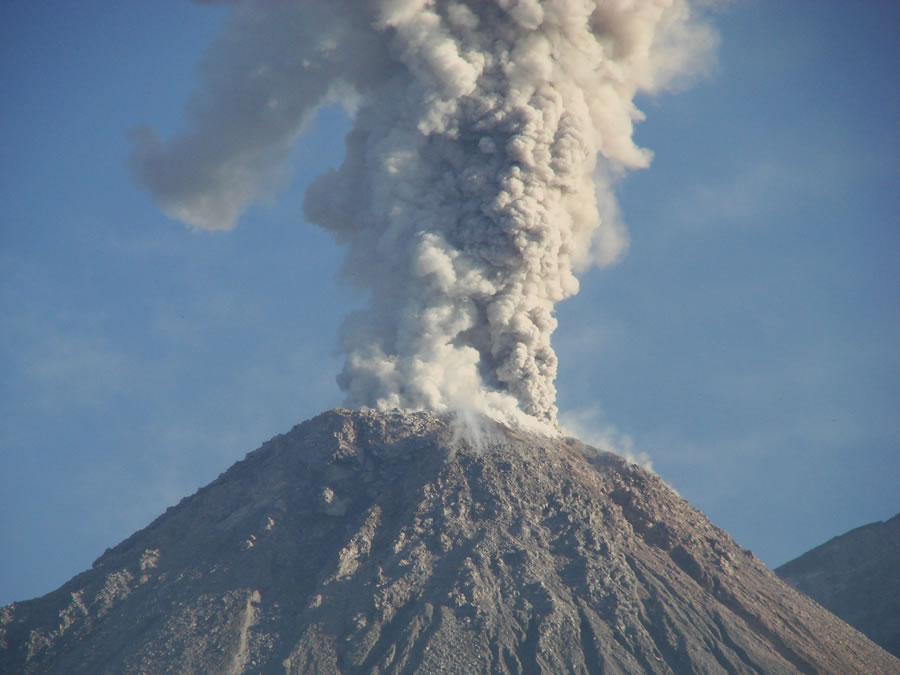
Ash
fall: Volcanic
ash mainly consists of small and sharp rock particles
formed from the breakdown of
magma. The explosive eruptions of volcanoes can
throw such ash particles over a long distance.
Ash fall effects includes:

- Difficulties to air travel through poor visibility or the risk of engine failure.
- Damage to roofs and other structures due to the acidic effects and weight of ash.
- Irritations to people are breathing passages, eyes and skin.
- Animals may also be affected because this ash contains glass which can be deposited in the grass and eaten by them.
- Contamination of drinking water .
Landslides and Lahars
Volcanic eruptions are generally accompained by dreadful vibrations in the surrounding areas, which cause landscapes. In the past, such landslides were responsible for burying surrounding cities. they can occur as a result of mobilization of the very weak deposits that are formed as a consequence of volcanic activity.
Lahar contains rocks, mud and water; and can travel long distancesat great speeds. They are consistent, viscose and dense: fluid when moving, solid at rest. a lahar of sufficient size and intensity can raze any structure in its path, and is capable of carving its own pathway, making the prediction of its course difficult.

Prevention of a Volcano
Currently, it is impossible to prevent a volcanic eruption, but it is possible to keep damage to a minimum. the following acts realized along the history can help to prevent an eruption:
Currently, it is impossible to prevent a volcanic eruption, but it is possible to keep damage to a minimum. the following acts realized along the history can help to prevent an eruption:
-To pour cold water onto flowing lava to slow
it down. (Iceland, 1973).
-Blast the holes in the hard crust covering a
lava flow using explosives. The lava then turns to flow out through the holes
instead of swallowing villages in its original path. (Mont Etna, Sicily. 1980)
-Explode dynamite in the volcano and release
the pressure built in it. (In Mexico,1919)
Before the volcanic eruption:
-keep some extra filters for your home
heating/cooling system. And have breathing masks and goggles for each family
member
-Store emergency food and water in your home.
-Find out if your community has a warning
system and know the warning signs.
-Create an evacuation plan. And define an
out-of-town contact for all family members to reach to check in.
During the
volcanic eruption
-Follow the directions of authorities.
-Take your family emergency kit and evacuate.
-When evacuating, if you are in a valley,
check upstream for mudflows. A mud flow is extremely heavy and can destroy a
bridge quickly. Take a different route or get to high ground quickly
Volcanic Activity On Mars
There are many volcanoes on Mars. The
planet is broken down into volcanic provinces for easier reference. Quite a few
of them are very large because the planet has not had tectonic plate action for
billions of years, so a single hotspot could flow for millennia.
Olympus Mons is a shield volcano on Mars and it is the
largest volcano in the Solar System. Located in the Tharsis region of the
planet along with three other large volcanoes, Olympus Mons measures 27 km in
height and is 3 times taller than Mount Everest. It is about 500 km in
diameter.
The mountain was formed from a single
hotspot that flowed for thousands of years. The lack of plate tectonics allowed
this flow and also prevented massive pressure buildups that would have blown
the top off of the volcano, decreasing its overall height.
The Most
Actives Volcanoes in the World
Though there are thousands of volcanoes on
the planet, only about 500 are currently active, and as many as 500 million
people live near an active volcano. Here are some the most active volcanoes on
earth.
 MOUNT ETNA, ITALY. Located on the island of Sicily. It is the largestactive volcano in Europe and has been active since 1500B.C. There are about 200 eruptions recorded: during the latest in 202. the lava flow reached the nearvy town of Nicolosi.
 PITON DE LA FOURNAISE: volcano located on the eastern side of Réunion island in the Indian Ocean. More than 150 eruptoins occurred since the 17th century with latest eruption on December 9, 2010 (lasting for two days). the volcano has been active for over 530,000 years.
Conclusion:
As we see, volcanoes are landforms which expels materials from inside to rhe Earth to ots outside. This material is called magma that is melt rock called magma. When it goes outside, it is called lava, and it is able to change the environmental that it cross.
Depending on the eruption it can be explosive eruption or an effusive one. The first one is the most violent, while the second is tinner. Even though we must take care with both of them because as lava as gases and pyroclastics materials than an active volcano can through are very dangerous and violent for the live in a place.
Because of that, people who live close to an active volcano (like the Kilaulea, the Mount Etna or the Piton de la Fournaise) is good to prevent with some prevent with some provisions and evacuation plans.
Spain also has volcanoes and it is good to teach everyone the cares and previsions if any time they start to work.
Questions:
1
.Could you explain what an effusive eruption is, and describe some common ones
of this classification?
2.
What are the names of the three different magmas that we can find?
a)
Basaltic, Andestic and
Rhyolitic
b)
Basalt, Andesite and Rhyolite
c)
Liquid magma, lava and melting rock
3.
What is magma?
a)
Molten fluid rock inside the volcano
b)
Molten fluid rock outside the volcano
c)
Where the lava is kept inside a volcano.
4.
Why there are eruptions?
a)
Because of heat
b)
Because of movement
c)
Because of gas pressure
5.
Why there are eruptions?
a)
Because of heat
b)
Because of movement
c)
Because of gas pressure
Web
site Analisys : (http://www.geology.sdsu.edu/how_volcanoes_work/)
Is this web site reliable? Is
it a good information source?
Yes, we think it is. This
webpage is a very complete source of information. It is an educational resource
that explains science, and volcanoes and everything related to them.
It is very complete because it
explains from how a volcano is formed, to the types of eruptions, going through
the types of lava that a volcano can spit or the types of volcanoes that are
around the Earth. But not only on Earth, it has also a very complete site about
volcanoes out of the Earth, like in the Moon or in Mars.
Although we think this website
is very good, we consider that its information is very complex. It could be
difficult to understand some concepts if you don´t have a minimum science
level. In the moment to select the information in this site, we have missed
more concepts about the consequences and different ways to prevent a volcano.
Even though we found some
difficult aspects, we definitely think this site is good.
Bibliography
- “Earthquakes, volcanoes
and Tsunamis, resources for Environmental Literacy” Environmental Literacy
Council, 2007, United States of America, NSTApress.
